
MINANGKABAU
The Minangkabau are a matrilineal culture whose homelands are in West Sumatra. The earliest accounts of their origins come from the Tambo a mix of legend, history and mythology that predates a written language.
Pak Edwardo Guci has this to say about the origin of the name Minangkabau :
“Minangkabau, the greatest of names in West Sumatra was known by people of old by its other name – the Pariangan Kingdom. It was established in the middle of the twelve Century, circa 1339 and began around the south-eastern slopes of the volcano, Mount Merapi. According to locals this information cannot be disputed since the history of Minangkabau nature or mind-set is known as “Tambo”. Tambo can be defined as that which up to this day has been confirmed and not in any way changed by the Minangkabau people.
Many people nowadays say that “Tambo” of the Minangkabau people contains mainly fiction with perhaps no more than 2% truth while 98% is pure myth. The name Minangkabau is nowadays wrongly interpreted as that which was derived from the Bull Fighting tradition. As the story is told it began with a fight between two buffalos. One was from Swarnadwipa (Java) and the other from Pariangan, Swarnabhumi (Andalas or modern day Sumatra). At that time the winner was the buffalo from Pariangan, therefore the land was named Minangkabau. “Minang” was interpreted as Menang or Win and “Kabau” is the name for buffalo in the language of West Sumatera.
However, the name of Minangkabau was already in use far longer than the existence of the Pariangan Kingdom, whose king was Adityawarman (1339 – 1376). It is believed that the name came into existence from the moment the first forefathers stepped onto the land around the slope of Merapi Volcano.
Something that also offers clues as to the origins of the Minangkabau word was found on an ancient inscription of the Sriwijaya Kingdom which states;
Swasti Cri Cakrawarsita 605 Eka Dacicu Klapaksa Wulan Waikasa Dapunta Hiyang Nayik Di Samwau Manalap Siddhayatra Di Saptami Culapaksa Wulan Jyestha Dapunta Hiyang Marlapas Dari Minanga Tamwan Mamawa Yam Wala Dua Laksa Da Nan Ko Ca Dua Ratus Cara Di Samwau danan Jalan Sariwu Tilu Ratus Sapulu Dua Wanakna Datam Di Matayap Sukha Citta Di Pancami Cukla Pasa Wulan …………..Langhu Mudita Datam Marbuat Wanua ………………Criwijaya Jaya Siddhayatra Subhiksa
which can roughly be translated as follow;
Congratulation on the leaving of Caka (Saka) year 605 on the date of 11 on the half-moon of Waichaka, the majesty of greatest man rides on a canoe set for the holy mission on the 7 of half bright of the Jyestha moon. The majesty was set from Minang Tamwan brought 20.000 soldiers with boxes 2000 was set with canoes while 1000 walked on the land 302 come to the matayap on the happy day on the 5 of……….. was established the town easily and happily criwijaya had won because of the holy mission
As can be seen, the inscription states clearly about the holy mission starting from Minanga Tamwan to Sriwijaya. Minanga means Binanga which can be translated as ‘river’, while Tamwan or Temon is the founding, therefore the words “Minanga Tamwan” means the estuary two twin rivers, left Kampar and right Kampar which is well known as the old area called ‘Muara Takus’.
Muara Takus was the central point of the spread of Buddhism Mahayana (730 – 1150). There have also been some in past that have said the word Minangkabau was derived from the word Pinang(a) Kabu which means “Base Land” or original land.
To conclude even though the bull is an important symbol of the Minangkabau way of life, this West Sumatranese people’s name did not originate from it. Minang people are fierce, proud and with a colourful history. As will be seen in later instalments our martial arts also have old and varied origins.”
Guru Edwardo Guci St Panduko
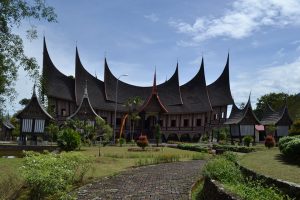
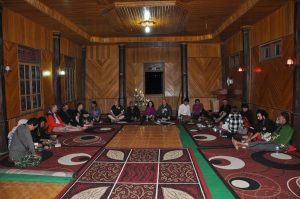
Their history and how they have adapted through time is particularly relevant to many of our modern issues of identity, globalisation and adaptation. Adat is the traditional law, the traditional knowledge that is part of Minangkabau life and it represents a body of information and practice that is unique but infused with historical influences. When to absorb and adapt, when to fight and reject, how to learn and assimilate without losing your identity and history are all questions that the Minang people have had to and still are struggling with. The pace of modern globalisation and digital technology has intensified this process.
Minangkabau is classified as an Austronesian language and is close to Malay though it is unclear when the two languages split from a common ancestor and the precise historical relationship between Malay and Minangkabau culture is not known. The Minangkabau are known in South East Asia for their learning and for their oratory. Formal speech as well as aphorisms and proverbs convey tradition, cultural history and moral information. The pidato adat (ceremonial oration) for example is performed by clan chiefs (panghulu) at formal occasions such as weddings, funerals, adoption ceremonies, and panghulu inaugurations.
As a matrilineal culture property and land is passed down the female line. The traditional Minangkabau house is elegant and distinctive with its curved roof that extends up into a point reminiscent of the buffalo horns. The rumah gadang, the traditional meeting house is beautifully decorated with ornate carving and floral patterns. The tradition of merantau remains significant in both the history and psychology of the Minangkabau, whereby young men travel from their homeland to seek their fortune and gain knowledge. There is both a deep appreciation of ‘home’ and a reaching out for new experience and learning. There is something initiatory and transformative in this practice for the individual and potentially enriching for the culture.
It was around the 16th century that Islam began to be adopted by the Minangkabau who have a rich spiritual and animistic tradition that predates Islam. Bhuddism also had significant influence in the 14th and 15th century. The Dutch East Asia company established trading links with Sumatra in the 17th century, a land rich in gold and spices.
An important tradition is Randai, a folk theatre of the people which brings together song, dance, story telling, drama and martial arts. Major performances may take place over several nights and the subject matter is usually made up of Minang legends and folktales. History, entertainment and moral code are all to be found in Randai. Music is equally distinctive. The saluang and bansi are wind instruments often played with a haunting yearning quality that speaks of separation and homecoming. The saluang requires a circular breathing technique to produce continuous uninterrupted sound. The seranai is another wind instrument that has a more piercing rhythmic sound and is made from buffalo horn. Talempong are percussive instruments that are played in hypnotic and driving syncopated rhythms.
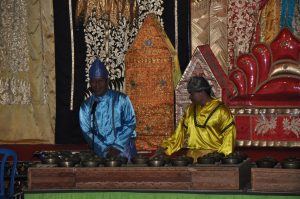

The tambua and tansa are percussive drums giving a bass and higher note not unlike the kick drum and snare in a western kit. Silek performed with live traditional music is a powerful transformative experience. As well as Randai there are many traditional Minangkabau dances with their particular social and ceremonial function, for example the tari piring which relates I believe originally to the harvest celebration. This requires balance coordination and great strength in the legs as many of the postures are low to the ground.
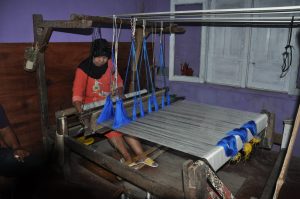

Indonesian textiles have beauty and ceremonial significance as well as practical function. The sarong is clothing, towel, blanket, bag and weapon combined, a wonderfully versatile garment. The traditional weaving in West Sumatra can also be rich, ornate and of great value. Gold thread in deep rich colours is characteristic. The salendang or shoulder cloth, the head scarf or deta and waist sash were all characteristic and significant. The traditional village life of pre 21stC Minangkabau led to a wide variety of expression of Adat and Islamic culture that was pertinent to a particular clan or area. This is very much like the expression of the different silek tuo styles that were associated with a particular village or area. There are many traditional motifs in the weave, some very old and found carved into rock. Below are two examples.
Kaluak paku (below left)
(fern tendril)
This is a spiral design that refers to a chief’s responsibilities to his children, his sister’s children, and his community. This motif is particularly hard to make on a textile because of the difficulty inherent in trying to weave a rounded pattern.


Batang pinang (Above right)
This is a narrow warp stripe that is likened to the areca palm and used to explain the ideal qualities of a Minangkabau mother. Like the trunk of this palm tree, she has integrity and she and her children stay close and grow together.
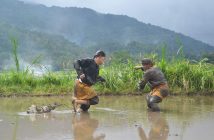
Minangkabau cuisine is varied and delicious. It is not surprisingly spicy and the chili content can be very high. Side dishes of sambal are ever present to increase the vigour. Rice is a staple and the Minangkabau evolved their own style of paddy-field farming which suited the wetlands of West Sumatra. The water buffalo is an important part of Minangkabau farming and a symbol of their strength and loyalty. Vegetables are large and plentiful and coffee, cinnamon, nutmeg and coconut form an important part of the cuisine and agriculture. Chili, turmeric, ginger and galangal are important flavourings. Rendang is a typical Minangkabau dish of which there are many. Another of my favourites is Padang sate.
Achijadi, Judi. Floating Threads: Indonesian Songket and Similar Weaving Traditions. Indonesia: BAB Publishing, 2016.
Hitchcock, Michael. Indonesian textiles 1991
Pauka Theatre & Martial Arts in West Sumatra – Randai and Silek of the Minangkabau 1998
www.auralarchipelago.com/auralarchipelago/gandangsarunai?fbclid=IwAR0sgaqvvC79_3t0G8HQ8g_thckXBy-xUtjpBZqoxykJHZL09eF4xk-ZP4M