

“The teacher/student relationship is an ancient and a sacred connection – (sacred, something set apart, a treaty and related to sacrifice – the performance of sacred things, sacra, facere). Sacrifice for the teacher and student, when the relationship is true, implies both parties offering something to the other and to the greater good without expectation of return. It is not the same as contractual payment where an exchange is agreed and there is clarity about the mutual obligation.”
There are many kinds of teacher student relationship. Some are superficial and involve exchanges of information with minimal payment or commitment on either party’s side. Some cut deeply and the exchange of knowledge is transformative and life changing. Some involve minimal contact but the impact of a brief encounter may endure. Some relationships persist over a lifetime and go through many stages.
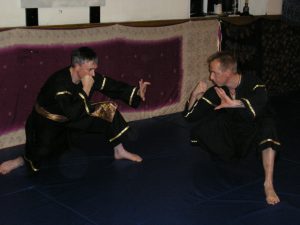
One of the most important things that I learnt about the teacher student relationship was that there were roles being played by both parties in order for something to happen. The teacher might switch role and become student in any given moment and vice versa. I try and work with this idea in my classes by ensuring that all students learn to teach as they also have to learn how to learn.
What is trying to happen in this relationship ? Something is being exchanged and placed into the vessel of the relationship. Nurture, care and the paying of attention. Inspiration and creativity so that the body of knowledge in an art grows whilst the participants change. The alchemical symbolism of lead turning to gold is an image that represents this process. Something invisible is trying to happen.
In training or a fight situation you are affected by the energy of your partner/opponent. The emotional content, the intent, has an effect. There is a transference of energy trying to take place, and likewise a countertransference. This is well described in psychology and is no less applicable in martial arts and the teacher student relationship. Notice how you feel training with one partner as compared to another, how over time you feel differently in your relationship with student or teacher. Bring some awareness to your relationships. Feeling becomes more important than content/technique, as you progress further.
Likewise a teacher may have a very particular effect on you. I recall one of my teachers who I would spend a great deal of time with. He never treated me like a student but more like a guest or visitor and at first I thought this was because I was from a different culture and we had no common language. I watched him with many students and in many situations and over time I began to feel differently. Something inside me began to feel stronger and clearer and after some years I realised that he had taught me something about what Carl Rogers called unconditional positive regard. He saw something positive in me and was free of any desire on his own part to take something, have something or for me to have to be formed in any kind of set way. This kind of inner freedom on behalf of the teacher or indeed of a parent is a precious quality. The parent or teacher does their best to provide conditions and support for the child or student to grow and learn and to become themselves. Inner freedom and lack of judgement is not to be confused with lack of discipline direction, or example.
Where it can go wrong is if the teacher attempts to mould the student in his or her own image rather than seeing what is growing as the student learns; or the student copies/mimics in such a way as to lose their essential character. Another difficult time can be when the student becomes ready to graduate or their growth means that they need another input. The teacher can deliberately or unconsciously hold the student back, or the student can push forward into teaching or independence before they are ready.
A student may need many teachers on the way, each address something different. Technique, knowledge, understanding, inspiration. Each will have their own qualities. As the student wakes up every situation becomes learning. The Minangkabau have a love of nature and life as teacher embodied in this saying “Alam takambang manjadi Guru”. Traditionally lessons and instruction in silek was not paid for in money as is done in the West and even today many teachers do not formally charge for instruction. Although there will be an exchange of many kinds it is not the same as contractual payment and can be fraught with difficulties for the student who is used to paying a set fee for a particular service.
In the West there has been a major change in awareness of relationship dynamics where there is unequal power. This has destabilised patterns of behaviour and relationships in many areas of life and much of this is overdue. The state, organised religion, the armed forces, the police, law, medicine, social services , the work place and education have all had examples of abuses of power brought to light. There is some confusion about how to relate. Money which is one of society’s ways of enabling power to be expressed is concentrated unequally. Concentration of wealth also means concentration of material power. If you look back in history there have been other times where the abuse of power has been challenged, for example the axial age.
What does all this mean for the teacher student relationship, for us? One question to ask yourself is the nature of your own moral code and that of your teacher or student. What are your values and do you live by them? Another useful question is to ask yourself what your expectations and obligations are. Many relationships come adrift because of unspoken assumptions and unrecognised needs on both sides. Learning involves change and vulnerability as well as fun and creativity. Trust and respect are vital components because any transformation in the martial arts will involve working with fear and anger and much more.
‘A man goes to knowledge as he goes to war, wide-awake, with fear, with respect, and with absolute assurance. Going to knowledge or going to war in any other manner is a mistake, and whoever makes it will live to regret his steps.’
“What makes a man ready, so that power can provide him with a teacher?”
“No one knows that. We are only men. Carlos Castaneda