
“To know means to know all. Not to know all means not to know. In order to know all, it is only necessary to know a little. But, in order to know this little, it is first necessary to know pretty much.”
― G.I. Gurdjieff
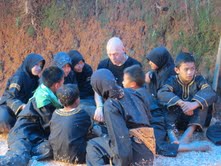
Recently I have been impressed by the way the students at Ripon silat are learning and growing in all kinds of areas in their training and how this is a reflection of what they are doing in their lives as a whole. One is developing his seeing and aesthetic sense through photograpy, another just completing his teacher training, one is learning to harness his natural strength and power and bring it out in his silat and self confidence in life, and another embarking on an arduous journey of self directed study and learning.
One of the things Ajarn Paul Pearson said at a recent seminar was something like “all the lessons of life are to be found in the ring, in your training.” Sometimes the lessons learnt find their way into life naturally and without thought and just as you may struggle to give yourself fully to your training it may also be hard to enter life fully. Many experts in a particular field struggle to transfer their skills into another. The beginners mind has to be revisited in many fields and not just in the one that you are comfortable with.
What might it mean to enter training and life fully ?
Martial artist often argue about what to learn, what is effective and of course if you have an immediate aim or goal then you are right to prioritise your learning but if your art is primarily about self-development about your growth as a human being, then there is no wasted learning. I always liked the story of the Zen tea master forced into the position of accepting a duel. Having no sword skills he sought instruction from a sword master who told him that it was useless to try and learn any technique in the time available and that he should be fully present in just the same way as he would in the tea ceremony. During the preparation for the bout the swordsman who had made the challenge sensed the presence and calm emanating from the tea master as he fully entered each movement, each moment and recognising that he was in the presence of a master, withdrew the challenge.
Brain imaging clearly shows that if we continue learning throughout life our brain transforms in both its structure and function. As we harden and grow more comfortable in our areas of expertise we can find learning more painful especially outside our chosen way. It is also true that the deeper our learning goes in a particular field the greater the possibility we have of this opening out into all areas of our life. Reflex criticism of self and other may suggest a defensive fear of opening our minds to understanding. Our reactions when we like one part of our training and not another tells us something about ourself.
Gurdjieff whose quote heads this piece also said that that there were 3 traditional paths of self development – The Way of the Faqir ie through the body. The Way of the Monk/Nun ie through devotion/emotion, and the Way of the Yogi ie through the mind. The Fourth Way became available at certain times in history where one might work on all rooms at once. Here the possibility of more rapid progress and deeper learning became accessible when one worked on mind, body and emotion in a balanced way. I have always found this a useful idea. It is so clear that our modern Western education emphasises the mind and neglects emotional and physical development.
How do I enter more deeply into my training, into life. What is my aim ? Which areas, mind, body or emotion are present and strong in my learning, which are weak or absent ? Play and have fun into old age.