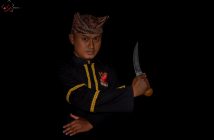

The kris is a South East Asian dagger strongly associated with Indonesia, but also very much part of Malaysian, Philippine and South East Asian tradition. It is thought to have developed in East Java from an earlier prototype, the keris buda, which coexisted and was preceded by a leaf shaped blade similar to certain Indian blades. The keris appeared in its more modern form around the 14th century as a thrusting asymmetric blade about 12-15 inches long with point and two sharpened edges, either straight or with an uneven number of waves.
In this article we look at the physical structure of the Kris, a little of its history and cultural significance, and discuss the symbolism and imagery associated with the Kris and its relevance to the Indonesian martial art of penjak silat. The imagery and symbolism associated with the kris and its form belongs to an ancient magical and spiritual tradition as well as reflecting the history and beliefs of the cultures that have given rise to it. It is a hard task to write about a subject that is so deeply a part of a culture that one was not born into. I am not qualified to do so but feel it is important to make the attempt and am partly motivated by my own struggle to find information . We teach our students in the UK and practice an art from another culture. Cross fertilisation and immigration of peoples and ideas has taken place from the moment early man left Africa and it has reached extraordinary levels in our technological age. My sources are a mix of personal conversation, internet and published texts. There is a huge regional variation in the history of the Kris that I know virtually nothing about so much of what I say is generalisation but I hope these pieces will open conversations and contacts with others who are better informed.
The history and evolution of the kris has much to say about martial arts and the ways we transform aggression. At one extreme we have warfare and conflict, the practical and destructive application of power whilst at the other we have harmony, beauty and creativity. The keris has evolved from a fighting weapon into a beautiful ceremonial form imbued with meaning and power. The keris helps affirm identity and the role of the individual as responsible adult within the community. It is valued in the family as pusaka , sacred heirloom and endowed with spirit and magical power. The keris required respect and proper care and if rightly matched to owner offered protection and success.
Indonesia has a rich past. The Java Homo Erectus fossils record that humans have inhabited western Indonesia for at least a million years. Modern man, Homo Sapiens Sapiens with stone tools, pottery, domesticated animals and crops date from around 2000 B.C. in Java and Sumatra, reaching these islands as part of the Austronesian migration. Indian influence and Hindu beliefs were making their mark powerfully by the 2nd-3rdC A.D. The great Bhuddist monument of Borobudur was probably consecrated in 824 A.D. a Bhuddist dynasty, the Shailendras having established themselves as rulers of Java by the early 8th Century B.C. The Majapahit empire (1300-1500 approx) which grew out of Java was probably responsible for important aspects of keris design and its spread. The oldest keris known in England were collected before 1637. From the 15th to 17th century A.D. Islam became a major influence. These waves of religious and cultural input were integrated into the indigenous values and beliefs of the various Indonesian islands.
The early indigenous beliefs and practices have variously been described as animistic, shamanistic, the way of the Great Spirit. Some of these are unique to a particular area and many are the local flowering of fundamental, archetypal beliefs and practices that are to be found throughout the world. These early magical and mystical beliefs and practices, together with later religious and cultural influences are like the metals of the kris folded and forged together to form a rich and potent structure which has its own unique nature. In modern times many authors have commented on the rise of mystical movements in the 20C. The Javanese who comprise almost half of the Indonesian population exemplify this. ‘Kebatinan’ literally inwardness, is used to describe the many streams of mysticism which are concerned with the spiritual life and ‘Kejawaan’ the essential cosmology, ideas and practices which inform the behaviour and ethics of everyday life.
In most cultures the smith acquired a magical reputation working with metal ore and forging weapons, tools and objects of art. The keris and gamelan gong smith was given the title empu associated with men of power . It was a title used for sage-priest and court poet. They shared the power of transformation. Raw material becomes weapon or musical instrument – word becomes poem and transmitted wisdom. There is an acknowledgement of the power to create and destroy, to heal and transform. The empu had outer and inner skill and was craftsmen, artist and shaman in the sense of acting as bridge between worlds.
Fire as source of heat and light provides protection and nourishment. It also has great destructive and creative power. It can transform food and iron ore. It is a medium through which the souls of ancestors could be released or an ancestral spirit enabled to enter the blade being forged.
From the raw materials used to the process of creating and caring for the blade there is an alchemical journey which we can learn from. Iron ore is taken from the earth and married with pamor, the meteorological nickel from the heavens brought together with fire and fused into a new creation. This mirrors the development of the human mind and soul. Raw material – matter, infused with spirit and forged in the heat of long practice gives rise to a mind that is capable of creative action in the world.
All Kris have an associated hantu or spirit each with its own particular character and qualities. Some of these qualities are associated with the tutelary spirit and ancestors of the keeper of the Kris, some with the qualities of the keeper him/herself. Some are imparted and connected to the pande who is the maker and forger of the Kris. The pande’s art is sacred and he is recognised as one who has access to the spirit world, and as such, no matter how humble his family status, is addressed as empu or kyai (lord, master). Here, the construction of the Kris is seen as a process in which spirit is connected to and expresses itself through what might otherwise be seen as a material object. The blade becomes a medium of communication with the spirit world and in particular one’s ancestors and therefore was traditionally passed down through the family, or from teacher to student. As such, the Kris is also strongly associated with fire and some blades are attributed with the physical power of being able to carry fire from one place to another. Symbolically, the fire represents ancestral energy and qualities passed down through the generations. Other powers attributed to certain blades include the ability to warn of impending danger, of telekinesis, of tuju (directing of energy for healing or wounding), and of communicating with wild animals.
The structure and shape of the Kris is variable and individual but there are characteristic features. The mata Kris, or blade, is usually curved and normally about 12 inches-15 long. The number of its waves are variable but are always an odd number. Symbolically odd numbers are generally associated with a transformative process and even numbers with a complete form. The blade is pointed and sharp on both edges and is therefore able to cut and thrust. A narrow channel may run the length of the blade on both sides or, occasionally, there will be two parallel channels either side of a raised rib. The blade is not given a sealed smooth finish but remains rough and frequently has small cracks said to be variably associated with poor workmanship, mystical meaning, and to hold liquids for poisoning or healing.
The aesthetics of blade form are highly significant. The empu is smith and sculptor. There is dapur (the blades fundamental shape), wangun (a quality of harmony relevant to each part of the blade) and udawadana (totality) a sense created by the whole. Guwaya is a term which refers to the effect on the viewer of the blade – an impact combining artistic and magical qualities. There are traditional elements within the form and also room for the individual empu to make his own unique contribution.
The pamur or etched patterns in the metal of the blade are an important feature. These appear as circular or wavy veining in the metal of the blade and historically are thought to have been derived from the early use of a variety of metals including impurities and nickel found in meteors. In more modern times commercial nickel has been used. Layers of metal are hammered and forged to form the blade and holes, and channels created while the blade is hot and soft. After forging, blade patination takes place using a solution of lime juice, arsenic and sulphur. It is interesting to note the use of arsenic and sulphur two of the main alchemical elements each of which has its own rich symbolism and use in homoeopathic medicine. The solution is brushed on in the heat and light of the sun and as the iron oxidises black the whitish pattern of the nickel stands out in relief. There is the powerful alchemical image of the emergence of purity from the essential raw material which is analogous to the human soul beginning to shine as its true form is revealed in the life of the individual.
Pamur evolved into designs developed by the individual pande and there are said to be five classical designs associated with the five pandawas of the Hindu-Javanese epic.
Wos wutuh: rice grains
Sekar pala: nutmeg flowers
Sekar ngadeg: erect flowers
Blaraq nigirid: coconut leaves
Sekar tumu: curcuma flowers
There are other symbolic meanings associated with pamor. These include wengkon (border like) a line which forms around the edge of the blade and is protective in function. It often encloses tambal (patch) symbolic of the power to provide what is needed. Another classic pamor is adeg (upright standing form) a line running along the spine of the blade and symbolising the individual who is the keeper of the blade. Gazing into the pamor design can be a divinatory exercise or meditation to open ones inner sight and intuition.
The base of the blade has a raised collar guard, known as the ganja, which is either forged as part of the blade or joined as a separate piece. The ganja is not uniformly thick, having one end widened, the dagu, whilst the other is sharpened, the aring. There are multiple serrations below the aring and two projections below the dagu). The uppermost of these is the smaller and known as lambaigaja, the elephant’s tusk, while the lowermost is an inward curving spike, the belalaigaja, the elephant’s trunk. They are said to have a mystical significance. The names suggest some ideas. The elephant’s trunk is both a tool and an extraordinarily sensitive appendage capable of feeling, communicating, and discriminating, while its tusk is more obviously a weapon with a dramatic display and decorative function.
The ulu or handle is hand-carved, usually from an ornamental wood. It fits the hand as a natural curve flowing out of the blade enabling a pistol grip hold and is usually about 4–5 inches long. In some designs the angle is sharper, more like the handle of a walking stick. Historically, the design of the ulu has been traced to two main forms, the tungaqq semi or budding tree trunk, and the pasisiran or littoral (shoreline). A classic Javanese form is the jawa demam, the fever-stricken man, resembling a person hugging himself as if shaking with the chills of fever. Early designs featured animals, e.g., the eagle Garuda, and also human forms and Hindu deities. Later, the Islamic influence resulted in these forms evolving into abstract representations.
The sheath is also fashioned of ornamental wood and may be encased in a layer of metal below the sampir or crosspiece or at the tapered end, the buntut. The Javanese sheath is distinctive due to its boat-shaped crosspiece. The shape and design of the handle can be connected to certain time-periods and to particular geographical areas. Most importantly, however, the shape and form of the handle is part of the representation of the energetic pattern and spirit of the Kris and its keeper and should be allied to the nature and purpose in this life of the keeper and his/her ancestry.
The World of The Javanese Keris G &B Solyom
Mysticism in Java N Mulder
Weapons and Fighting Arts of Indonesia –Asian Fighting Arts Draeger
Religion & Ritual Indonesian Heritage
M H Young 2012